The Anatomy of an Utter Surrender: How Pakistan’s system sunk to historic lows at Edgbaston

The Anatomy of an Utter Surrender: How Pakistan’s system sunk to historic lows at Edgbaston
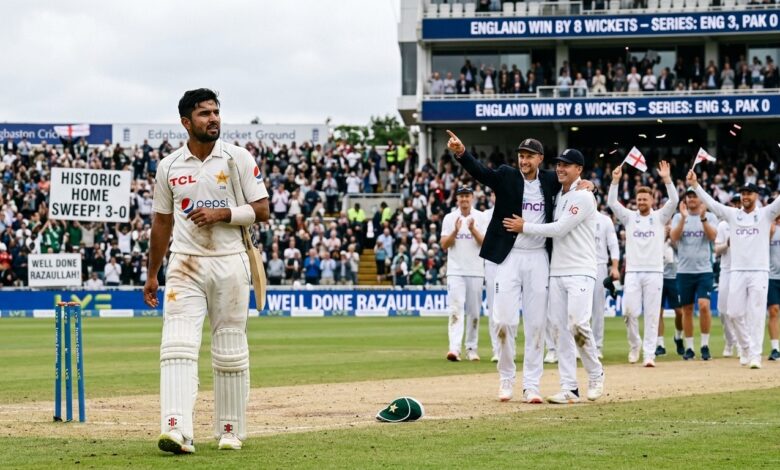
By Nawaz Gohar ; When the final act played out under the grey skies of Birmingham, the scorecards recorded an eight-wicket victory for England in the third Test, completing a unprecedented 3-0 home whitewash against Pakistan. But standard match figures fail to capture the sheer magnitude of the decay exposed during this tour.
This was not merely a tactical misstep or a string of bad sessions. This was, comprehensively, the single worst performance by a Pakistani Test side on English soil in modern history, an absolute collapse of technical competence, administrative sanity, and competitive spirit.
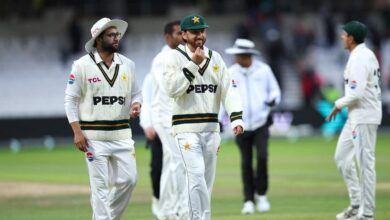
The humiliation suffered across this three-Test series was built long before the toss at Edgbaston. Between an embarrassing innings loss in the opener, a comprehensive drubbing at Lord’s, and the bizarre mid-series purge where seven squad members alongside head coach Sarfaraz Ahmed were abruptly dropped and sent home, the Pakistan Cricket Board (PCB) transformed a marquee international tour into a soap opera.
When captain Babar Azam openly admitted post-match that he was not even consulted regarding these mid-series replacements, the institutional anarchy was laid bare for the world to see. A team cannot fight on the field when the ground beneath them is being constantly pulled away by an erratic management culture.
If a team surrenders the first innings by getting bundled out for a miserable 133 runs, they forfeit the moral right to complain about the result.The technical shortcomings of Pakistan’s established top-order were exposed with ruthless efficiency by the English seam attack.
While Shan Masood (95) and Babar Azam (76) produced half-centuries in the second-innings trail-fight, these knocks served as mere band-aids on an open wound. The fundamental issue remains: when the pitch offers lateral movement or high bounce, the top order plays with heavy hands, zero defensive discipline, and an alarming lack of game awareness.
If anything spared Pakistan from complete, unmitigated ignominy, it was the raw, unbridled courage of two men: Mohammad Abbas and debutant Razaullah Khan. Where elite specialist batters succumbed meekly to the English pace battery, 21-year-old Razaullah walked out at No. 9—having already taken four crucial wickets in the first innings—and produced a masterclass in fearless hitting.
Razaullah’s blistering 81 off 63 balls—featuring nine towering sixes that equaled Ben Stokes’ record for the most sixes in a Test innings on English soil—was nothing short of spellbinding. Alongside Abbas, who scored a gritty 42 and bowled with incredible heart to snag early wickets in England’s final chase, the duo put on a heroic 121-run stand.
Their defiance did more than just avoid an embarrassing back-to-back innings defeat—it won the hearts of cricket purists from Edgbaston to Melbourne. It was a stark, almost poetic irony that a lower-order debutant with barely any first-class experience and a veteran pacer showed more spine, technical clarity, and tactical bravery than the entire specialist batting lineup combined.
The final World Test Championship (WTC) points table paints an ugly picture. Sitting dead last at 9th place with a pathetic 14.81% win rate, Pakistan Test cricket has hit rock bottom.
To move forward, Pakistan must stop treating deep structural flaws with cosmetic fixes: End the Musical Chairs: Sacking coaches, dropping half the squad mid-tour, and blaming green-top pitches are deflections.Rebuild First-Class Standards: Domestic pitches must prepare batters for seam and bounce, not pad individual averages. Empower Modern Intent: The fearless, unfiltered approach shown by Razaullah should be the blueprint, not the exception.
England deserved their historic 3-0 sweep; they were professional, clinical, and relentless. Pakistan, meanwhile, must look in the mirror. Unless radical, structural reforms replace cheap rhetoric and chaotic selection policies, this historic low in Birmingham won’t be an anomaly—it will be the new normal.