

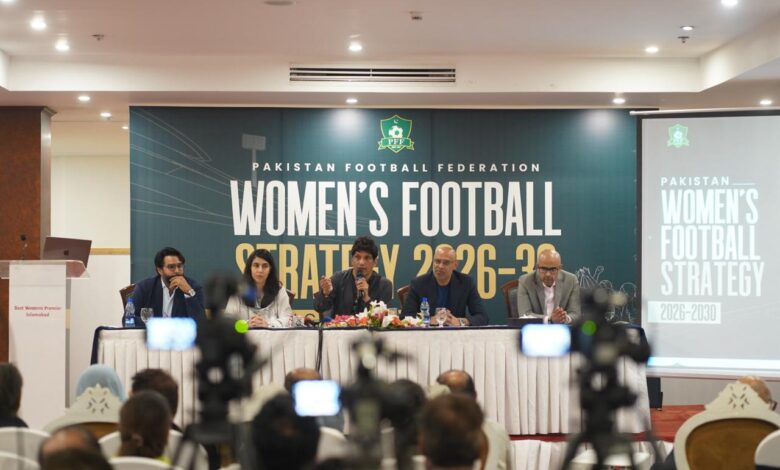
PFF unveils landmark 2026–2030 strategy to empower women’s football
By Nawaz Gohar ; The Pakistan Football Federation (PFF) has officially launched its landmark Pakistan Women’s Football Strategy 2026–2030. Unveiled under the banner “From Paper to the Pitch,” the strategic roadmap sets out an ambitious five-year framework designed to build a sustainable ecosystem for female athletes, coaches, referees, and sports administrators across the country.
The launch comes at a defining moment for the sport in Pakistan. With the women’s national team achieving unprecedented milestones—including making history at FIFA events and climbing above the men’s side in global rankings—the federation aims to turn short-term victories into a lasting legacy.
Presented by Head of Women’s Football Mejzgaan Orakzai, the 2026–2030 vision shifts the focus from sporadic participation to structured talent development. Build-out plans will leverage the existing base of 62 registered clubs, 673 registered female players, and certified coaching staff.
The strategic vision rests on five core pillars: Participation & Competitions: Establishing a tiered national, provincial, and district league structure, alongside an integrated registration and talent identification network.
Player Development & High-Performance: Launching Regional Training Centres, national youth development programs, and guaranteeing a minimum of 10 international matches annually for the senior national team.
Education & Capacity Building: Expanding pathways for technical officials by targeting the certification of 250 female coaches across four regions and scaling registered female referees from 5 to 100.
Visibility, Engagement & Commercial Growth: Driving media partnerships, fan engagement, and community outreach programs designed to reach over 2,000 young girls annually.
Governance & Safeguarding: Institutionalizing female leadership within sports management, enforcing club licensing criteria, and establishing transparent, professional player welfare frameworks.
Syed Mohsen Gilani, President of the PFF, said: “This is a historic moment for Pakistan women’s football. Our athletes have proven their mettle on the international stage. Our pledge today goes beyond producing players—we are building an ecosystem where women can thrive as coaches, referees, managers, and executive leaders.”
Mejzgaan Orakzai, Head of Women’s Football, said: “At its heart, this strategy is about developing women’s football from the ground up. We are not starting from zero; we are strengthening what exists. The pathway must begin with access—getting more girls playing in schools, clubs, and academies, backed by a system that identifies talent wherever it exists.”
Syeda Mehreen Sajid, Prime Minister’s Coordinator for Inter-Provincial Coordination, said: “Building a structured pathway gives our sports sector clear direction. My key hope is that the PFF vigorously reaches into smaller towns and rural districts alongside major urban centers, as some of our finest undiscovered talent is waiting right there.”
Leadership from the technical side stressed that the success of the 2026–2030 initiative hinges on grassroots execution. PFF Technical Director Adeel Rizki noted that youth development over the next three years will dictate the national team’s strength for the next decade, while Chief Operating Officer Shahid Khokhar emphasized the importance of aligning operational realities with high-level strategic goals.
As the PFF rolls out its Regional Training Centres and expands grassroots competitions through initiatives like Football for Schools, the strategy sets a clear goal: transforming football into one of the premier sports for women in Pakistan by 2030.