
Dawn of a New Era: How a 19-year-old prodigy just rewrote the modern WTA playbook in Paris
Exclusive Article By Nawaz Gohar

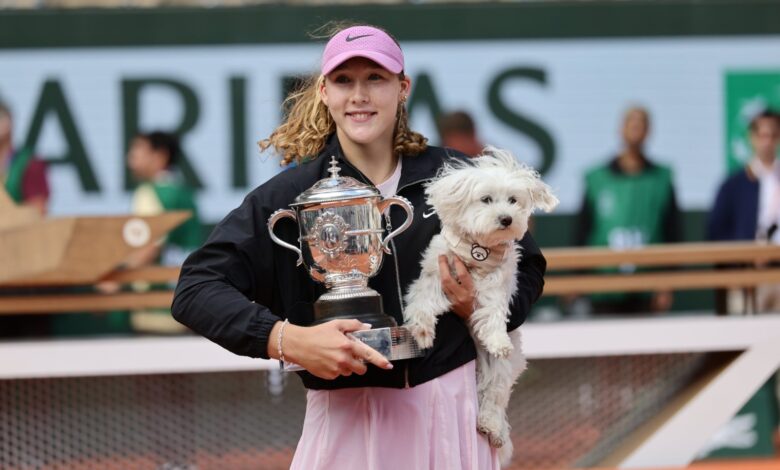
Dawn of a New Era: How a 19-year-old prodigy just rewrote the modern WTA playbook in Paris
By Nawaz Gohar ; For over a decade, women’s tennis has been locked in an exhausting cycle of short-lived breakthroughs. We have grown accustomed to the “one-and-done” Grand Slam phenomena, players who capture lightning in a bottle for a fortnight in Paris or New York, only to fade under the crushing weight of sudden expectation.
Then came Mirra Andreeva’s Roland-Garros campaign. What we witnessed on the Parisian clay was not a fortunate convergence of a soft draw and hot streaks. It was a clinical, cold-blooded coronation. By dismantling Poland’s Maja Chwalinska 6-3, 6-2 in the final, the 19-year-old did more than just lift her maiden Grand Slam trophy; she shattered the modern illusion that teenage prodigies lack the emotional stamina to dominate the sport’s highest echelon.
To truly appreciate what Andreeva accomplished, one must look past the trophy and dissect the sheer arrogance of her numbers. Becoming the youngest women’s singles champion in Paris since Monica Seles in 1992 is a historical footnote that deserves more than a passing glance. Seles’s era was defined by a ruthless, uncompromising style of tennis that broke opponents mentally before breaking them physically. Andreeva operates on a remarkably similar frequency.
Entering the tournament as world No. 8, she did not just win seven consecutive matches—she suffocated the field. Dropping a singular, solitary set in the second round, she proceeded to treat the remainder of the draw like an advanced training session. Heavyweights and seasoned dirt-ballers like Sorana Cirstea and Jil Teichmann were simply bypassed.
Nowhere was this psychological edge more apparent than in her semifinal vengeance against Marta Kostyuk. Weeks prior, Kostyuk had bested Andreeva in Madrid, arriving in Paris riding an intimidating 17-match clay-court winning streak. A lesser, more inexperienced player would have carried the scar tissue of that Madrid loss onto Court Philippe-Chatrier. Instead, Andreeva flipped the script with a terrifying 6-1, 6-3 demolition. That is not just talent; that is a rare, retaliatory sporting intellect.
Tactically, Andreeva is redefining what it means to be a modern baseline defender. Traditional clay-court counter-punchers rely on attrition, hoping to outlast their opponents through endless rallies. Andreeva, conversely, uses court coverage as an offensive weapon. Her movement in Paris was predatory; she covers the lines with an elastic grace that forces opponents to over-index on their risks, inevitably triggering unforced errors.
Her statistical footprint for the season—sitting on a tour-leading 35 victories—proves that her Parisian masterclass was merely the culmination of a year-long siege. Having already conquered Dubai in 2025 as the youngest WTA 1000 winner, alongside early-season titles in Adelaide and Linz, the French Open title feels less like an unexpected arrival and more like an inevitable mathematical certainty.
It is impossible to ignore the cultural ghosts Andreeva has awakened. As the first Russian woman to hoist a Grand Slam singles title since Maria Sharapova’s triumphs a decade ago, she inherits a legacy of intense, ice-veined competitiveness. Yet, whereas Sharapova relied on flat, screaming power, Andreeva possesses a far more nuanced, multidimensional chess game.
The WTA Tour has spent years searching for a stabilizing force—a generational anchor capable of turning rivalries into eras. At just 19 years old, Mirra Andreeva has demonstrated the consistency of a veteran and the fearlessness of youth.
Roland-Garros will not be remembered as the peak of her career, but rather as the baseline. The rest of the tennis world has officially been put on notice: the teenage apprenticeship is over, and the Andreeva era has begun.