Safety Before Glory – The First Responsibility of Sports Federations
By Shahid Ulhaq, Sports Philanthropist, Journalist & Analyst

Safety Before Glory – The First Responsibility of Sports Federations
By Shahid Ulhaq, Sports Philanthropist, Journalist & Analyst
Beyond medals, trophies, and records, the very foundation of sports lies in the safety and protection of those who participate.
Athletes are not just performers in arenas; they are human beings who dedicate their lives to their craft, entertaining fans and raising the honor of their nations. When their safety is compromised, the credibility of any competition collapses.
The recent CMAS Freediving World Championships in Mytikas, Greece highlighted this truth in the most alarming way. Russian freediver Andrey Matveenko suffered a severe medical episode after a deep dive attempt. The absence of proper medical facilities on-site, the delay in accessing a hyperbaric chamber,
and the silence of CMAS officials not only endangered his life but also shook athletes’ trust in the system. Many top athletes, in protest, withdrew from the competition—sending a powerful message: No medal is worth risking life without adequate safeguards.
This was not an isolated incident. In fact, history across sports provides painful reminders:
In boxing, South Korean fighter Kim Duk-koo tragically died after his 1982 bout with Ray Mancini. His death led to reforms, including shortening championship fights from 15 to 12 rounds and stricter medical supervision.
In mixed martial arts (MMA), numerous fighters have faced life-threatening brain injuries due to delayed medical attention. The case of Joao Carvalho, who died after a 2016 fight in Dublin, forced Irish regulators to reassess protocols.
Even in sports like wrestling and weightlifting, athletes have collapsed due to overexertion, dehydration, or doping-related complications—yet often without immediate medical intervention.
Here I would also like to mention that in 2016, when I was planning professional wrestling entertainment events for the revival of international sports in Pakistan, my top focus was on safety concerns of international standards.
At that time, I prepared a global standard safety checklist for every sports event, whether local or international, which I consider very important. In my view, the following safety principles must be mandatory for every sport.
Each of these tragedies reinforces one fact: sports without safety is negligence disguised as competition.
To prevent repeats of such incidents, every sporting event—whether local, national, or international—must adopt a universal safety framework:
1. Comprehensive Risk Assessment – Evaluate the specific dangers of the sport (concussions in boxing, blackouts in freediving, dehydration in marathons).
2. Qualified Medical Team – Presence of certified doctors, paramedics, and sport-specific specialists (neurologists for combat sports, diving physicians for aquatic events).
3. Emergency Equipment On-Site – Hyperbaric chambers, defibrillators, oxygen kits, and ambulances stationed at the venue.
4. Institutional Coordination – Local hospitals and trauma centers pre-alerted and integrated into the event’s emergency response plan.
5. Athlete Medical Screening – Pre-competition fitness certifications, including heart and brain scans for high-risk sports.
6. Clear Communication Protocols – Public and immediate updates on incidents to ensure transparency and accountability.
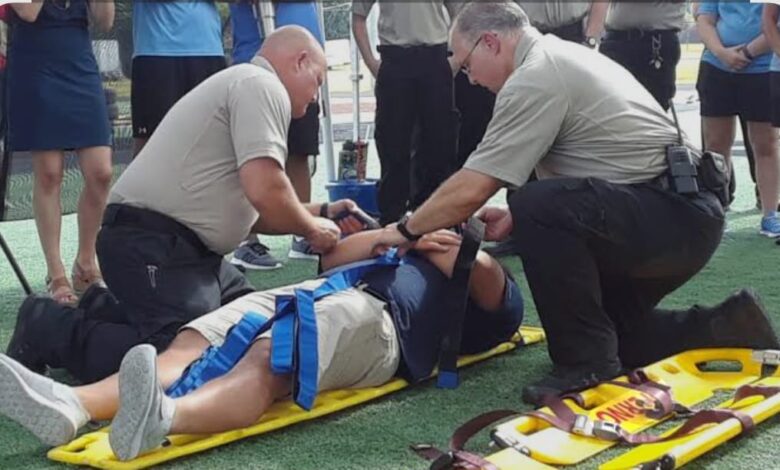
7. Mandatory Safety Drills – Organizers, staff, and medical teams must rehearse emergency procedures before the competition begins.
8. Independent Safety Officers – Neutral experts authorized to halt an event if safety standards are compromised.
9. Insurance and Welfare Guarantees – All athletes, staff, and officials covered for injuries, accidents, or long-term consequences.
10. Fan and Official Safety – Secure crowd management, emergency exits, and evacuation plans to protect spectators and staff.
In Pakistani sports, there is a particular need to adopt international standards.
For Pakistan, where sports are struggling to revive their international stature, the lesson is clear. Before issuing any NOC (No Objection Certificate) to organizers of domestic or international events, federations and authorities must:
Conduct a safety audit based on the above checklist.
Ensure compliance with international medical and security protocols.
Demand proof of emergency facilities, insurance, and coordination with local authorities.
Establish an independent monitoring cell within the Pakistan Sports Board to certify safety compliance.
The lives of athletes, fans, and officials must never be gambled for short-term glory or political gains. Every tragedy diminishes trust, while every precaution strengthens the culture of sportsmanship.
Sports federations exist not just to produce champions, but to protect them. Safety is not an accessory—it is the very foundation on which the future of sports must stand.
Shahid Ulhaq ; Sports Philanthropist | Senior Sports Journalist | Fitness & Event Expert
Email: spofit@gmail.com | YouTube: SPOFIT