Beyond the Medals: What the World Taekwondo President’s Cup means for Pakistan

Beyond the Medals: What the World Taekwondo President’s Cup means for Pakistan
By Nawaz Gohar ; The conclusion of the Treet World Taekwondo 8th President’s Cup (Asia Region) 2026 in Lahore deserves to be viewed as more than simply another entry on Pakistan’s sporting calendar.
Yes, the medals matter. Yes, the final standings matter. But the greater significance of the championship lies in what Pakistan has demonstrated by successfully bringing a major international taekwondo event to its own soil—and in what it can potentially learn from the experience.
The competition, staged at the Garrison Jinnah Sports Complex, Lahore Cantt, produced a fascinating contrast. Iran emerged as the dominant force in senior kyorugi, while Pakistan claimed the top position in poomsae. That contrast tells us something important about the current state of Asian taekwondo and, more importantly, about where Pakistan can improve.
Iran finished at the top of the senior kyorugi standings across the 16 weight categories with an impressive haul of seven gold, one silver and eight bronze medals. Korea followed with five gold, four silver and six bronze, while Kazakhstan took third with two gold and three bronze.
Pakistan finished ninth in senior kyorugi—a result that should neither be exaggerated as a failure nor dismissed as insignificant. Instead, it should be treated as a clear indicator of the distance Pakistan still has to cover in the most competitive areas of international taekwondo.
Pakistan’s Poomsae Success is Worth Celebrating ;
Where Pakistan truly made its mark was poomsae, where the hosts topped the overall standings with three gold, three silver and nine bronze medals.
Korea finished second with three gold and one silver, while Iran secured third with one gold, three silver and three bronze. Afghanistan, Egypt and Sri Lanka completed the next three positions.
Pakistan’s poomsae performance should therefore receive the recognition it deserves. It demonstrates that Pakistani athletes are capable of competing successfully when given the right platform, quality opposition and exposure to international standards. But there is also a larger lesson here.
Success should not merely be celebrated; it should be studied. What did Pakistan’s successful poomsae athletes do differently? How were they prepared? What coaching methods worked? How much did competing against international opponents at home contribute to their performance?
These are the questions that administrators and coaches should now be asking. Because the real value of a championship is not only the medals won during four or five days of competition. Its real value is what remains after the medals have been put away.
The Kyorugi Gap Cannot Be Ignored ;
Pakistan’s ninth-place finish in senior kyorugi provides an equally important message. Iran’s commanding performance, along with Korea and Kazakhstan’s strong medal hauls, underlines the depth and quality that exists in Asian taekwondo. Pakistan cannot expect to close that gap through occasional international appearances or short-term preparation alone.
Kyorugi demands sustained investment in athletes, coaching, sports science, physical conditioning, tactical preparation and regular exposure to elite competition. If Pakistan genuinely wants to become a serious force in international taekwondo, the focus must move beyond participation.
The objective should be consistent podium finishes. That requires a long-term athlete-development pathway rather than a system that becomes active only when a major championship approaches.
Lahore’s Biggest Victory May Have Been Off the Mat ;
There is another dimension to the President’s Cup that deserves considerable attention: Pakistan successfully hosted a major international sporting championship.
International athletes, coaches, officials and delegations arrived in Lahore and competed under the same roof. That matters. For Pakistani athletes, competing at home against high-level international opposition provides invaluable experience. They get to observe different styles, understand the pace and intensity of international competition and test their preparation without the additional burden of travelling abroad.
For Pakistan, however, the benefit goes further. International sporting events provide an opportunity to demonstrate organisational capacity, sporting infrastructure and hospitality to a global audience. They can also contribute to Pakistan’s broader sporting diplomacy.
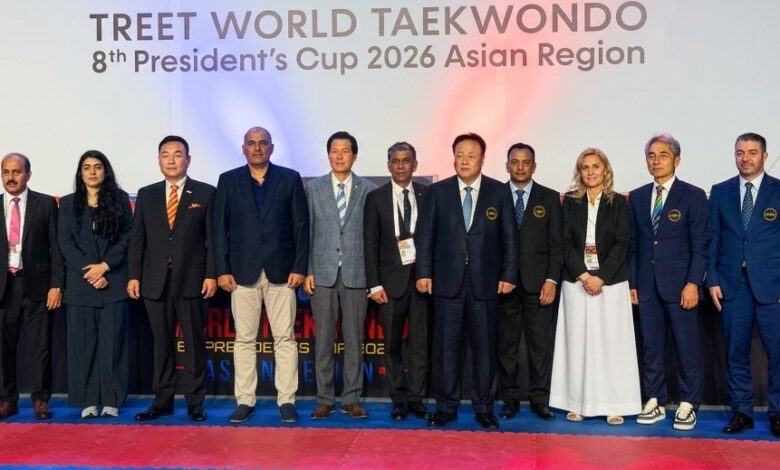
Punjab Sports Secretary Fazal ur Rehman, who attended the championship as chief guest, rightly highlighted the importance of hosting international competitions and their potential to create opportunities for young Pakistani athletes.
He also pointed to the wider promotional and diplomatic value of bringing international athletes and delegations to Pakistan. That aspect should not be underestimated. Sport can sometimes achieve something that conventional diplomacy struggles to accomplish: it brings people together through competition, creates personal relationships and allows visitors to experience a country beyond headlines and stereotypes.
Expertise Behind the Event Matters. The successful administration of an international championship also depends heavily on technical expertise.
The event was overseen by ATU Referee Committee Chairman Ki Su Lee and ATU Vice President Rajendran Muthusamy, whose involvement added international technical experience to the competition.
For Pakistan, such exposure is particularly valuable. Hosting an international event should not be viewed simply as an exercise in venue management. It should be an opportunity for local officials, referees, coaches and organisers to learn how major championships are conducted according to international standards. That knowledge can become one of the championship’s most enduring legacies.
The Question Now Is: What Happens Next?
This is where Pakistan’s sporting authorities need to think beyond the headlines. A successful championship cannot be allowed to become a one-off achievement. The athletes who competed in Lahore need continued opportunities. The young competitors who watched them need pathways into the sport. Coaches need development programmes. Officials need international exposure. Talented athletes need regular domestic and overseas competition.
Most importantly, Pakistan needs to turn international hosting into a development strategy. If an international championship arrives, generates headlines, distributes medals and then disappears from the sporting calendar without a meaningful follow-up programme, much of its potential value is lost.
But if the event becomes a starting point for systematic talent identification, coaching development, international competition and athlete support, its impact could continue for years.
From Hosting Events to Producing Champions ;
Pakistan has repeatedly demonstrated that it possesses sporting talent. The challenge has never been solely about finding talented athletes. The greater challenge has been creating an ecosystem capable of turning talent into sustained international success.
The President’s Cup offers a useful blueprint. Host major events. Expose Pakistani athletes to elite competition. Identify weaknesses. Learn from stronger nations. Invest in coaching and sports science. Provide regular international exposure. Then measure progress.
That is how medals become a consequence of a system rather than isolated moments of brilliance. Iran’s dominance in kyorugi should motivate Pakistan, not discourage it. Korea’s consistency should provide another benchmark. And Pakistan’s success in poomsae should prove that the country can compete at the highest level when preparation and opportunity come together.
The Lahore championship therefore leaves Pakistan with both a celebration and a challenge. The celebration is clear: Pakistan ruled poomsae and successfully hosted an important international taekwondo championship.
The challenge is even clearer: turn this momentum into a long-term programme capable of producing champions across disciplines. Because ultimately, the success of an international sporting event should not be measured only by how well the closing ceremony goes.
It should be measured by what happens to the athletes after the lights go out, the medals are packed away and the international delegations return home. That is where the real test of Pakistan’s sporting commitment begins.