The Green Shirts’ long-awaited Renaissance: Is Pakistan hockey finally coming home?

The Green Shirts’ long-awaited Renaissance: Is Pakistan hockey finally coming home?
By Nawaz Gohar ; For millions of Pakistanis, field hockey is not merely a pastime or a sport listed in record books; it is deeply interwoven with our national identity and collective memory. For nearly two decades, however, watching the Green Shirts was an exercise in nostalgia and heartbreak.
A nation that once ruled global hockey with four World Cup titles and three Olympic gold medals was reduced to an afterthought, haunted by administrative infighting, financial negligence, and humiliating qualification misses.
Yet, sports—like history—operates in cycles. Today, for the first time in years, the air around Pakistan hockey smells less like disillusionment and more like genuine promise.
The visible shift began when administrative turbulence was confronted head-on with structural reform. The appointment of Mohyuddin Wani as President of the Pakistan Hockey Federation (PHF) brought a seasoned bureaucratic hand to a system long crippled by ad-hocism. Rather than offering empty platitudes, the focus pivoted toward stability, player welfare, and institutional discipline.
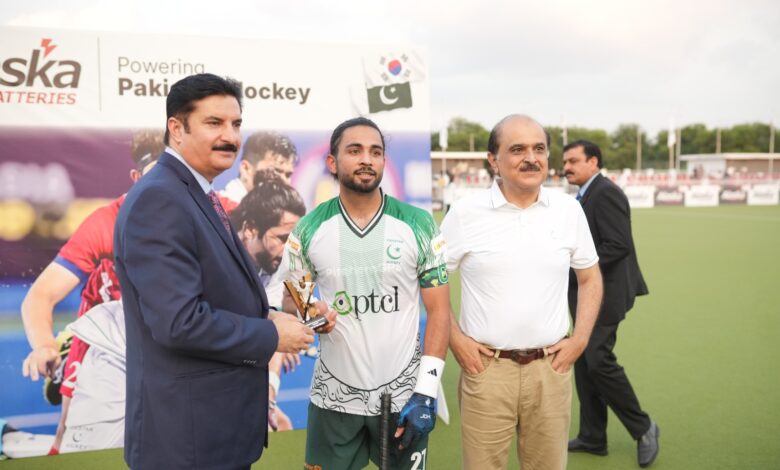
The immediate dividend of this steady leadership was felt on home turf. The arrival of the South Korean national hockey team for a home series in Pakistan was a monumental victory for domestic sports diplomacy. More importantly, the action on the turf matched the ambition off it.
Pakistan didn’t just play host; they played like contenders. Winning the opening encounters convincingly demonstrated something that had been absent for years: relentless competitive intent and tactical composure under pressure.
The revitalization isn’t solely administrative; it is visible in squad dynamics. The decisive move to entrust the captaincy to Abu Bakar Mahmood—made through deliberate consultation with senior Olympians—has injected fresh energy into the locker room. Leading from the front with clinical performances, Abu Bakar embodies a new breed of Pakistani player: disciplined, modern in execution, and resilient.
During their recent campaign in the FIH Pro League, the raw scores didn’t always favor Pakistan, but the brand of hockey was undeniably transformed. Facing world-class opponents, the team abandoned defensive panic in favor of structured pressing and fluid attacking lanes. They learned how to suffer on the field without collapsing—a prerequisite for top-tier survival.
The true testament to this resurgence is Pakistan’s qualification for the FIH Hockey World Cup after an agonizing eight-year absence. Rejoining the sport’s flagship event is not the destination, but it is the ultimate benchmark.
We must remain realistic. Decades of structural decay cannot be erased in a single season. Modern field hockey demands relentless physical conditioning, cutting-edge video analytics, and continuous exposure to elite competition. The PHF must ensure that grassroots academies are revitalized and domestic pathways are secured so that this momentum isn’t a brief flash in the pan.
However, the foundation has been laid. For the first time in a generation, the Green Shirts look organized, hungry, and proud of the crest on their jerseys. As the World Cup approaches, Pakistan hockey is no longer just reflecting on past glory—it is actively building its future.