
PHF secures landmark MoUs with Alaska Batteries and Sky 47 to revive hockey
By Nawaz Gohar ; In what is being hailed as a watershed moment for Pakistan’s struggling national sport, the Pakistan Hockey Federation (PHF) has officially locked in crucial private sector partnerships aimed at pulling the game back from the brink of obscurity.
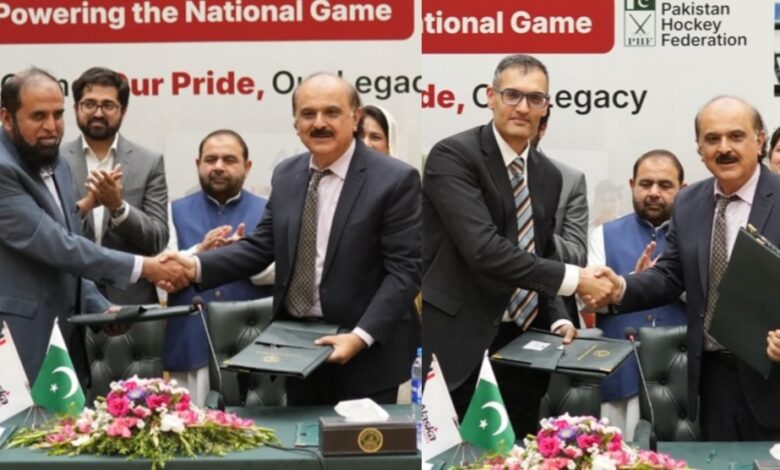
At a high-profile ceremony hosted at the Amir Khan Boxing Gymnasium within the Pakistan Sports Complex in Islamabad, the PHF inked two separate, milestone Memorandums of Understanding (MoUs) with corporate heavyweights Alaska Batteries and Sky 47.
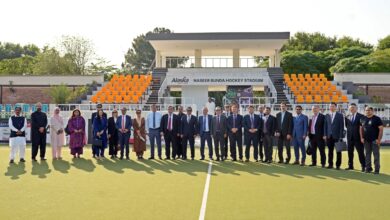
The gathering brought together a powerful coalition of sports architects, including Ministry of Inter-Provincial Coordination Secretary and PHF President Mohyuddin Ahmad Wani, Federal Minister Aurangzeb Khichi, alongside former Olympians, current players, and corporate leaders.
Speaking with an air of measured realism rather than empty rhetoric, PHF President Mohyuddin Wani acknowledged that reversing decades of decline cannot happen overnight. “This is not a one-day task,” Wani stated candidly. “But we are laying down the stepping stones today, and our support for hockey will be relentless at every single level.”
Rather than just focusing on cosmetic quick-fixes for the senior national team, Wani unveiled an aggressive grassroots strategy targeting the ultimate foundation of the sport: children aged 10 to 12. In a massive nationwide push, the PHF plans to introduce structured hockey programs into roughly 1,000 schools this year alone—marrying the resources of federal and provincial governments with private enterprise.
“Hockey is woven into our national identity,” Wani remarked, evoking nostalgia. “We want to bring back the golden aura of 1984 and the historic 1994 World Cup triumph. To do that, we must cultivate the culture anew.”
Addressing the historical skepticism surrounding sports funding in the country, Wani issued a staunch guarantee regarding the new corporate influx. He assured stakeholders that every single rupee from Alaska Batteries and Sky 47 would directly benefit the athletes. “This money belongs strictly to the players,” Wani asserted. “It will be funneled directly into their welfare, modern training facilities, and prepping them to meet international standards.”
Federal Minister Aurangzeb Khichi echoed this optimism while addressing members of the Under-18 squad in attendance, labeling them the literal future of the sport. Khichi frankly noted that Pakistan’s global hockey dominance waned significantly when the international game transitioned from natural grass to synthetic AstroTurf—a shift that exposed Pakistan’s massive infrastructure deficit.
However, Khichi remains confident that aggressive talent-scouting hunts stretching across both major hubs and remote towns will bridge the gap. “With the right mentorship and sustained investment, I have zero doubt Pakistan will reclaim the Champions Trophy, the Asia Cup, and the World Cup,” he insisted.
The corporate partners expressed deep pride in joining the rescue mission. Haroon Mehmood, Chairman of Alaska Batteries, emphasized that the country’s raw talent remains unmatched and merely needs a platform. Meanwhile, Sky 47 CEO Hassan Abbas framed corporate sponsorship not as charity, but as a “national responsibility” to empower the youth.
The initiative also received a strong nod of approval from sporting icons. Former hockey Olympian Tauqeer Dar lauded the federation’s direction, while former cricket captain Rashid Latif added his voice to the cause, reminding the audience that institutional backing and corporate synergy are the only real-world engines capable of driving a sport back to world-class status.
As the ink dried on the MoUs, the atmosphere in the gymnasium felt less like a standard corporate signing and more like the opening whistle of a long-awaited comeback.